
Bucharest’s Concrete Dictatorship: Where to Find Communist Brutalism and Why the World Can’t Look Away
Bucharest is a city that refuses to make sense. Walking its streets in Bucharest on a tour, you might pass a delicate Belle Époque villa with wrought-iron balconies, then turn a corner and find yourself dwarfed by a wall of gray concrete blocks that seem to have been dropped from another planet. This is not accidental. It is the physical residue of a regime that tried to rewrite a city’s story in concrete and marble, and largely succeeded. The result is one of Europe’s most bizarre and compelling urban landscapes—a place where the ghosts of communism are not hidden away in museums but loom over every boulevard, every square, every housing block. And increasingly, travelers from around the world are coming to see them.
Understanding the Beast: What Makes Bucharest’s Brutalism Different
Soviet Brutalism in Bucharest is not quite the same creature you find in Tallinn or Moscow or East Berlin. Romania’s communist regime, particularly under Nicolae Ceaușescu, developed its own architectural language—one that blended the raw concrete aesthetic of béton brut with a neoclassical grandiosity that was distinctly, almost absurdly, Romanian . Ceaușescu did not simply want to build functional socialist housing. He wanted to build a capital worthy of his own legend.
The turning point came in 1971, when Ceaușescu visited North Korea and was captivated by what he saw. Kim Il Sung’s Pyongyang was a city of monumental avenues, vast plazas, and buildings designed to make the individual feel small before the state . Ceaușescu returned to Bucharest with a vision. He would rebuild his capital in the same image—a “Balkan North Korea,” with himself as its pharaoh .
The 1977 earthquake provided the pretext. The disaster damaged large swaths of the city, giving Ceaușescu the justification he needed to push through a sweeping program of “systematization”—a euphemism for demolition and reconstruction on a scale that had not been seen in Europe since the Second World War . Entire historic neighborhoods were erased. Churches, synagogues, hospitals, schools, and thousands of homes disappeared. The old Bucharest—the “Little Paris of the East”—was sacrificed to the dictator’s concrete dream .
What replaced it was something unprecedented: a cityscape of monumental government buildings, wide boulevards lined with uniform apartment blocks, and at the center of it all, a palace so vast that it defies comprehension. This is the architectural legacy that tourists now come to see—not despite its difficulty, but because of it.
The Palace of the Parliament: The Monster at the Center
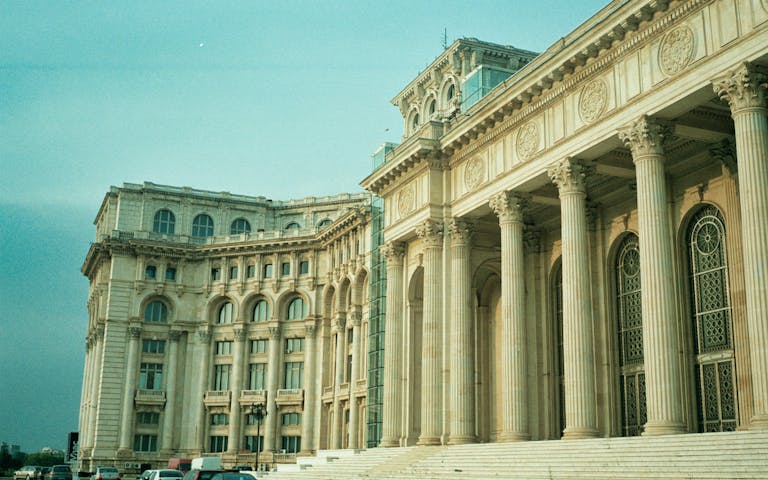
There is no way to write about communist Brutalism in Bucharest without confronting the Palace of the Parliament. It is the elephant in the room, the mountain on the horizon, the building that swallows the sky. Originally called the House of the Republic, later the People’s House, it is the second-largest administrative building in the world after the Pentagon, and the heaviest building on Earth .
The numbers are almost meaningless in their magnitude. The palace weighs approximately 4.1 million tonnes. It contains one million cubic meters of marble, 700,000 tonnes of steel and bronze, 900,000 cubic meters of wood, and 3,500 tonnes of crystal . It has roughly 1,100 rooms, though estimates vary because no one has ever needed to count them all. It rises 84 meters above ground and plunges 92 meters below it. The pressure of its own weight is so immense that it sinks approximately six millimeters into the Bucharest soil every year .
Construction began in 1984, under the direction of chief architect Anca Petrescu, who was only 28 years old when she won the competition to design it. She led a team of some 700 architects and oversaw a workforce that at its peak numbered 100,000 people, working in rotating shifts around the clock . Soldiers, civilians, and reportedly forced laborers all contributed to the effort. While official records acknowledge 27 deaths during construction, unofficial accounts suggest the true number was far higher .
The human cost was staggering even before the building rose. To clear the site, Ceaușescu demolished roughly a fifth of central Bucharest. The Uranus-Izvor district, one of the city’s oldest neighborhoods, was almost entirely erased—about 90 percent of it was lost. Approximately 10,000 homes were destroyed, around 20 churches were demolished, and 57,000 families were relocated . The area that disappeared covered roughly 7 square kilometers.
Ceaușescu never saw the palace completed. He was overthrown and executed on Christmas Day, 1989, five years after construction began. The building was finally finished in 1997, and today it houses Romania’s Senate, Chamber of Deputies, and Constitutional Court, along with several museums . But only about 30 percent of the building is actually in use. The rest—vast ceremonial halls, endless corridors, ornate staircases—sits largely empty. Maintaining it costs millions of dollars annually just for heating and lighting .
The palace is now the most popular tourist attraction in Bucharest. In 2013, nearly 150,000 tourists visited; by 2018, that number had risen to over 260,000, with more than 80 percent of them foreigners . They come to walk its marble corridors, to gawk at the chandeliers and handwoven carpets, and to try to comprehend how one man’s ego could produce something so enormous.
Beyond the Palace: Where to Find Communist Brutalism in Bucharest
The Palace of the Parliament is the headline act, but it is far from the only example of communist-era architecture worth seeking out. Bucharest’s Brutalist landscape extends across the city, from monumental civic buildings to the vast housing districts that reshaped its edges.
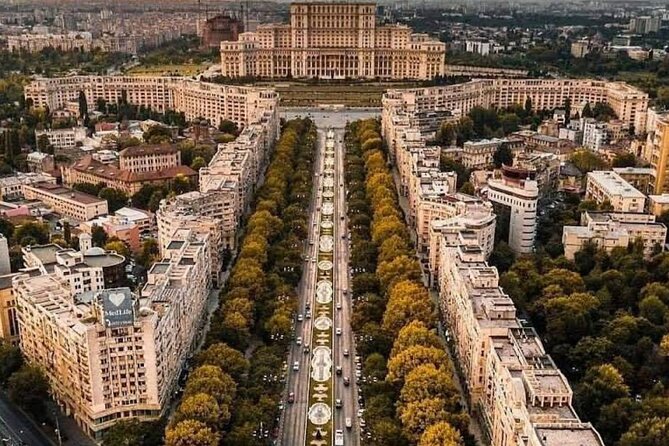
The Civic Center and Bulevardul Unirii constitute the palace’s supporting cast—and they are impressive in their own right. The Boulevard of the Victory of Socialism, now Bulevardul Unirii, was designed to rival the Champs-Élysées. It stretches from Union Square to the palace, lined with uniform apartment blocks and punctuated by a long row of fountains . The entire ensemble is a masterclass in totalitarian urban planning: the wide boulevards, the symmetrical buildings, the way the palace looms at the end of the axis, always visible, always dominant. Walking this route is to understand how architecture can be used to communicate power.
The Omnia Hall, designed in 1967 by architect Cezar Lăzărescu, is a lesser-known but significant example of Romanian Brutalism. Part of the former headquarters of the Central Committee of the Romanian Communist Party, it was used primarily for party rallies. Its exterior is stark and monumental, while its interior featured wooden decorative elements referencing folkloric traditions—a strange marriage of brutalist form and nationalist symbolism. The building is slated for renovation as the home of the National Center of Dance, though its original interior will be dismantled .
The former Party Academy on Bulevardul Iuliu Maniu is considered by some to be the first brutalist building in Bucharest. Now housing the Faculty of Electronics of the Polytechnic University, its modernist lines and raw concrete facade set the template for what followed. Nearby, the Leu student dormitories from the early 1970s offer a different flavor of the same aesthetic .
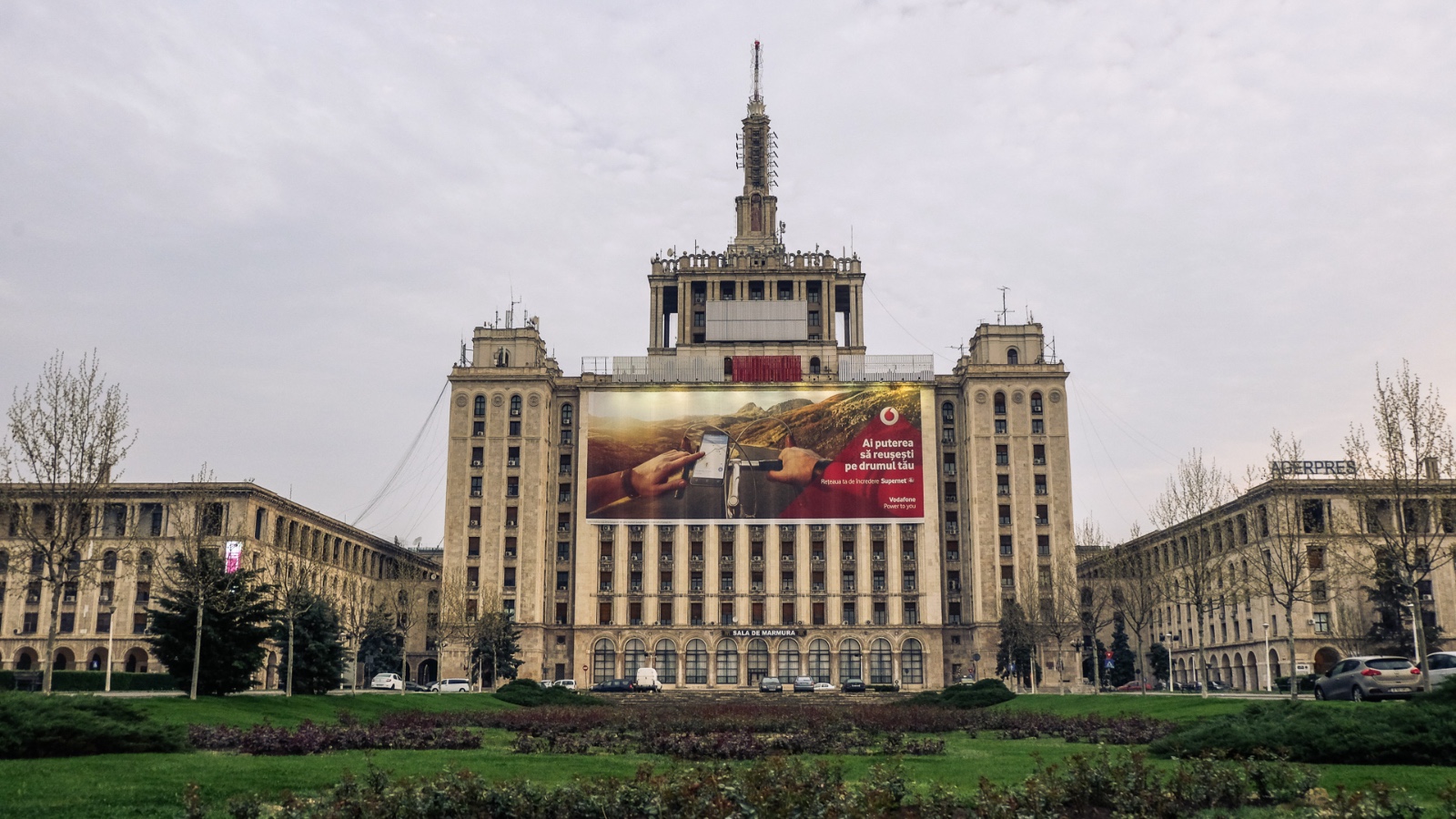
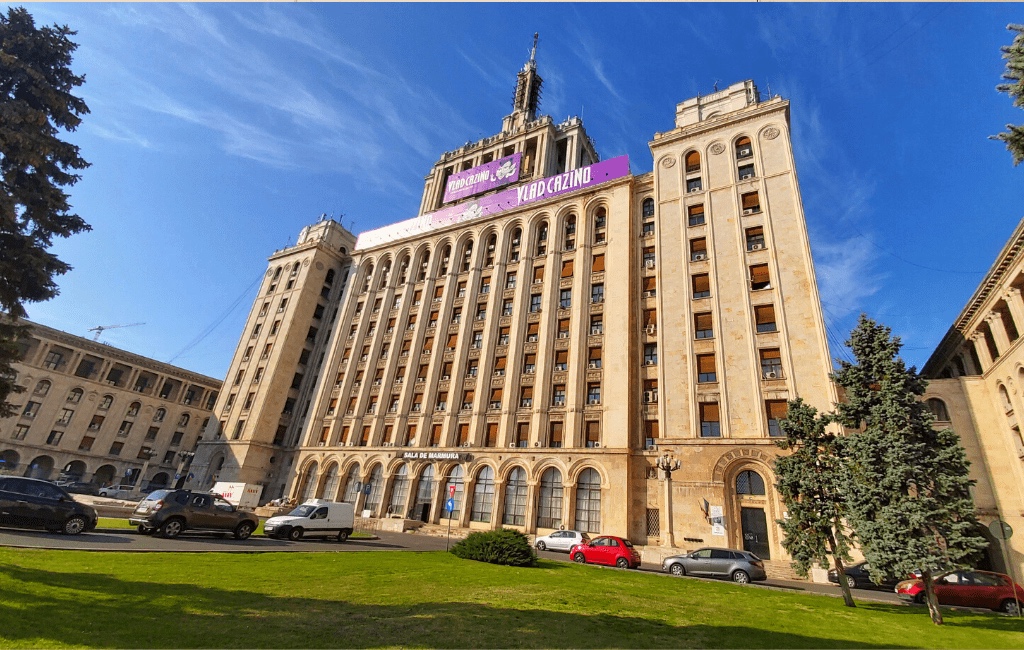
The Casa Presei Libere, or Free Press House, is another monumental communist-era structure. Once the center of propaganda and media control, its architecture reflects the Soviet-influenced design language of the 1950s. It remains a prominent landmark on the city’s skyline .
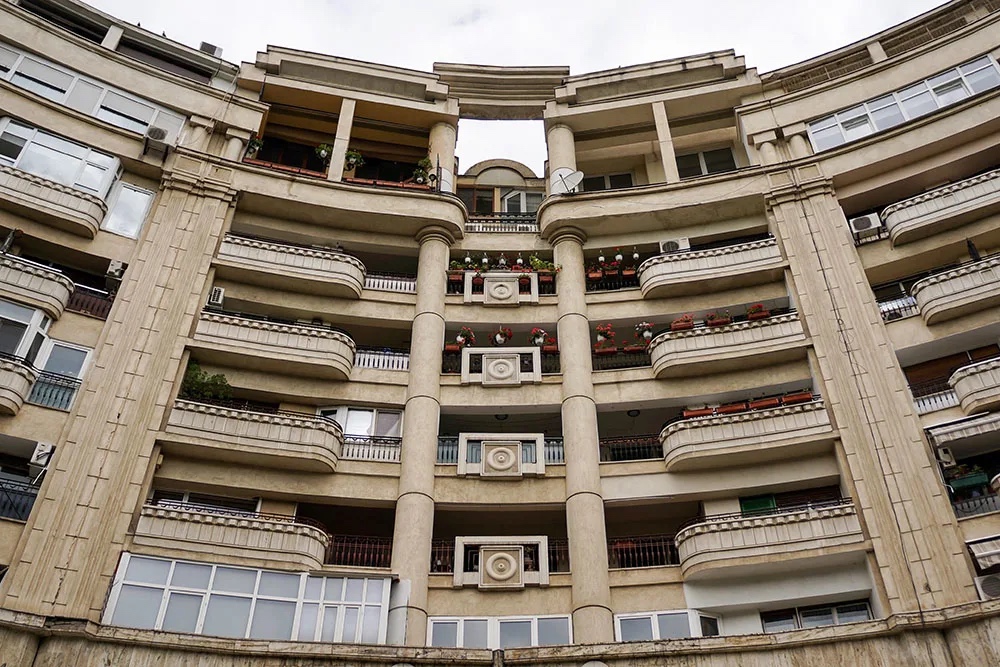
Communist residential neighborhoods are everywhere in Bucharest. You do not need to seek them out; you will encounter them whether you intend to or not. During the regime’s systematization program, low-rise historical buildings were demolished en masse to make way for high-density concrete blocks. In the center alone, 40,000 people were relocated to make room for the palace and its surroundings . The districts of Drumul Taberei, Titan, and Giurgiului showcase some of the more considered urban planning of the era, though the buildings themselves are uniformly gray and prefabricated . These blocks are not beautiful in any conventional sense. But they are historically and sociologically fascinating—a physical record of how the regime attempted to homogenize and control its population through the built environment.
Why Tourists Are Drawn to Bucharest’s Concrete Past
The popularity of communist-era tourism in Bucharest is a phenomenon that would have seemed unthinkable in the 1990s, when Romanians wanted nothing to do with the memories of Ceaușescu. As one tour guide put it: “After the revolution, we didn’t want anything to do with these memories of communism. We wanted to expel it from our lives” . And yet today, “communist tourism” is a thriving industry, with the Palace of the Parliament and the Ceaușescu Mansion ranking among Romania’s top tourist attractions .
Why? The answer is layered.
First, there is the sheer, undeniable spectacle. The Palace of the Parliament is not just a building; it is a natural wonder of human ambition and excess. Tourists who have never lived under a totalitarian regime find it difficult to comprehend that such a thing could exist—that a single man could order the destruction of a city’s heart and the construction of a monument to himself on such a scale. The building’s very existence provokes questions: How? Why? What does it mean? The scale is so far beyond ordinary experience that it becomes a kind of dark fairy tale, a cautionary tale written in marble and steel.
Second, there is the voyeuristic fascination with dictatorship. The Ceaușescu Mansion, now a museum, draws hundreds of visitors daily, two-thirds of them foreigners. They come to see how the dictator lived—the golden faucets, the indoor swimming pool, the private cinema, the gardens where peacocks once roamed—while ordinary Romanians endured shortages and repression . This contrast between the luxury of the elite and the deprivation of the masses is the stuff of fascination. It is history made personal, tangible, almost intimate.
Third, there is the rise of “dark tourism”—travel to places associated with death, disaster, and suffering. Bucharest offers several sites that fit this category, from the Palace of the Parliament to the Targoviste barracks where Ceaușescu and his wife were executed. In 2022, around 4,500 mostly foreign tourists paid to enter the courtyard where the executions took place . For many, standing in these places produces a visceral response—a lump in the throat, a chill, a sense of connection to events that suddenly feel very recent.
Fourth, there is the architectural interest. Brutalism has undergone a critical rehabilitation in recent decades. Once dismissed as ugly and inhuman, it is now appreciated by many architects and enthusiasts for its honesty, its sculptural qualities, and its historical significance. Bucharest offers one of the richest concentrations of communist-era architecture in Eastern Europe, from the monumental civic center to the residential blocks that house the majority of the city’s population. For architecture tourists, it is a destination of genuine importance.
Fifth, there is the contrast. Bucharest is a city of jarring juxtapositions. The Belle Époque elegance of Calea Victoriei, recently scrubbed of its communist-era grime, sits alongside the brutalist Civic Center . The revitalized Old Town, now one of the liveliest nightlife districts in Eastern Europe, is just across the Dâmbovița River from the monumental emptiness of the palace district . This fragmentation, this visual chaos, is itself an attraction. It tells the story of a city that has been rewritten again and again, without ever fully erasing what came before.
The Future of the Concrete Past
Bucharest’s communist-era architecture is not going anywhere. The Palace of the Parliament is too large, too heavy, too embedded in the city’s fabric to be demolished or fundamentally altered. The residential blocks that house hundreds of thousands of people are permanent features of the urban landscape. The question is not whether these buildings will survive, but how they will be understood and used.
There have been attempts to reimagine them. In 1996, an international competition called “Bucharest 2000” sought proposals to reconfigure the Civic Center, including a plan to break up the central axis with a lake and negate the palace’s symbolic impact with surrounding tower blocks . The project was abandoned due to lack of funds. Other buildings have been renovated and repurposed—the Omnia Hall, the former Party Academy, various institutional buildings from the communist period . But the fundamental tension remains: these buildings are both architectural heritage and painful reminders of repression. They cannot be easily celebrated, and they cannot be easily erased.
For now, they stand. The palace sinks millimeter by millimeter into the Bucharest soil, a slow collapse that may take centuries to complete. Tourists line up daily to walk its corridors. Guides tell stories of megalomania and suffering. And the concrete, gray and implacable, continues to hold the city in its grip.
For the traveler willing to look beyond the postcard, Bucharest’s communist Brutalism offers something rare: a chance to walk through history as it was lived, not as it has been prettified. It is not always comfortable. It is not always beautiful. But it is unforgettable. And that, perhaps, is the point.
Book your Communist brutalism tour in Bucharest with GetLocals.

Bryn Jacobs Chief Editor
Hello dear Travelers! I am Bryn Jacobs and I am your travel advisor. Having a vast experience in traveling throughout Eastern Europe and having researched this part of the world myself. I write articles on the site about travel experiences in Eastern Europe with statistics and interesting facts.