
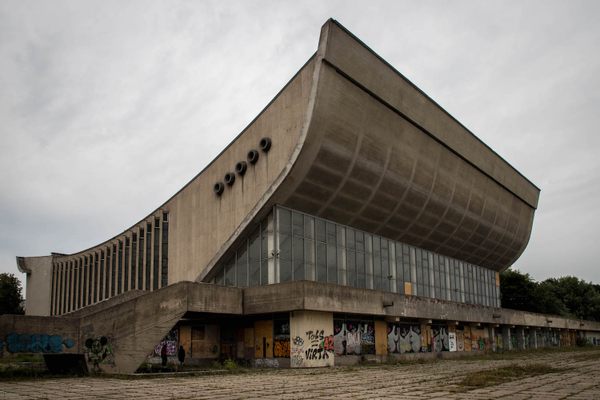
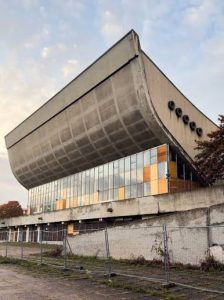
Vilnius, Lithuania — On the right bank of the Neris River, just across from the pastel baroque spires and cobbled alleys of Vilnius Old Town, sits a building that seems to belong to another world. Its raw concrete frame, cantilevered roof, and dark glass panels rise from the riverbank like some stranded spacecraft—monumental, weathered, and utterly abandoned. This is the Palace of Concerts and Sports, known locally as Sporto Rūmai, and it is arguably the most striking example of Soviet brutalism in Lithuania’s capital .
For decades, it hosted basketball games, rock concerts, and political rallies. Today, it stands empty behind a chain-link fence, its windows grimy, its interior off-limits. Yet tourists keep coming. They photograph it from the river promenade and from Gediminas Hill. They sign up for guided tours that stop at its perimeter. They seek it out precisely because it is difficult: a relic of a painful past, frozen in concrete, refusing to disappear.
Understanding why this building—and the broader brutalist landscape of Vilnius—exerts such a pull requires looking beyond aesthetics. It means confronting a history that Lithuania has spent three decades trying to make sense of, and recognizing that the appeal of Soviet brutalism lies partly in its honesty. These buildings do not pretend. They are what they are: products of an occupation, shaped by ideology, now bearing witness to its collapse.
What Soviet Brutalism in Vilnius Actually Is
The term “brutalism” derives from the French béton brut—raw concrete—and was popularized by the Swiss architect Le Corbusier, whose Unité d’Habitation in Marseille (1952) became a template for monumental concrete architecture worldwide . In the Soviet context, the style took on a distinct character. After Stalin’s death in 1953, architects across the USSR were freed from the ornate, neoclassical constraints of Socialist Realism. They began experimenting with exposed concrete, geometric forms, and structural innovation—often looking westward for inspiration even as the Cold War hardened .
Vilnius, as the capital of the Lithuanian Soviet Socialist Republic, became a laboratory for this new architecture. The city’s postwar expansion demanded new civic buildings, sports facilities, and cultural centers. Local architects like Eduardas Chlomauskas, Zigmantas Liandzbergis, and Vytautas Čekanauskas seized the opportunity to create something formally ambitious within the ideological constraints of the system .
The results are scattered across the city. The Palace of Concerts and Sports (1971) is the most famous. But brutalism in Vilnius extends far beyond a single building. The Lithuanian National Opera and Ballet Theatre, the Contemporary Art Centre, the Wedding Palace, and the sprawling university campus in Saulėtekis all bear the marks of the style . So do the TV Tower—the site of the January 1991 crackdown—and the residential districts that ring the city center .
What unites these buildings is not just their material—reinforced concrete—but their attitude. They are assertive, sometimes aggressive, often beautiful in a way that resists easy affection. They were designed to project the power and modernity of the Soviet state. That they now stand as monuments to its failure is part of their strange power.
The Palace of Concerts and Sports: A Case Study in Concrete and Contradiction
No building better illustrates the complexities of Vilnius brutalism than Sporto Rūmai. Completed in 1971, it was designed by architects Eduardas Chlomauskas, Jonas Kriukelis, and Zigmantas Liandzbergis, with engineers Henrikas Karvelis and Algimantas Katilius . The structure’s defining feature is its cable-stayed roof—a sweeping, wave-like form that appears to float above the main hall, its crest pointing toward Gediminas Castle. The chief engineer received a state award for the innovation .
Inside, the building could seat 4,400 spectators for basketball and volleyball, or host concerts and political gatherings . Its foyer featured a wall of wavy wooden strips—a warm, organic counterpoint to the concrete exterior. The main hall combined white-painted wood with exposed reinforced concrete, an unconventional pairing that reflected the era’s experimental spirit .
But the building’s history is inseparable from darker currents. It was constructed on the site of Piramónt (Šnipiškės) Cemetery, the oldest Jewish burial ground in Vilnius, established in the late 15th century. Soviet authorities destroyed the cemetery in 1949 and 1950 to make way for the sports complex, despite protests from the city’s Jewish community . For decades, the destruction went largely unacknowledged. In 2006, the building was added to the registry of architectural heritage sites, and the adjacent parking lot was converted into a memorial lawn . But the controversy remains unresolved. In 2022, Lithuanian Prime Minister Ingrida Šimonytė suggested the Palace could be transformed into a memorial to Lithuanian Jews, inspired by Warsaw’s POLIN museum .
The building also played a role in Lithuania’s independence movement. In October 1988, it hosted the founding congress of Sąjūdis, the reform movement that would lead the country toward independence . In January 1991, after Soviet troops killed 13 civilians at the TV Tower, the Palace served as the venue for their public funeral .
It remained in use after the Soviet collapse, briefly converted into a shopping and exhibition complex in the late 1990s. But in 2004, it was closed permanently after being deemed structurally unsafe . Since then, it has stood empty, occasionally opened for events like Open House Vilnius, but otherwise inaccessible .
Where to See Soviet Brutalism in Vilnius
The Palace of Concerts and Sports (Rinktinės g. 1) is the essential starting point. While the interior is closed, the exterior can be viewed from the river promenade, the Green Bridge, or Gediminas Hill. The best light is at sunrise and sunset, when the concrete takes on warm tones and the building’s silhouette becomes most dramatic . Guided walking tours of Soviet Vilnius typically include it as a key stop .
The TV Tower (Sausio 13-osios g. 10) is another brutalist landmark with profound historical weight. Its concrete shaft rises 326 meters above the city, and its observation deck offers panoramic views. On the ground floor, the Museum of the Struggle for Freedom documents the January 1991 events, when Soviet tanks attacked civilians defending the tower. The surrounding memorial, with its crosses and bullet-pocked walls, is deeply affecting .
The Lithuanian National Opera and Ballet Theatre (A. Vienuolio g. 1) is a more elegant example of the style, its concrete forms softened by glass and careful proportions. It remains a working cultural venue and can be admired from the outside or experienced from within during performances .
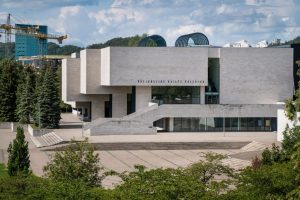
The Contemporary Art Centre (Vokiečių g. 2) occupies a brutalist building in the Old Town, its concrete frame contrasting sharply with the surrounding baroque architecture. It hosts exhibitions of contemporary art and is a good place to see how brutalist structures can be adapted for modern cultural use .
Saulėtekis University Campus (Saulėtekio al.) lies north of the city center and contains some of the finest brutalist architecture in Vilnius. The dormitories, with their sixteen-story concrete frames and rhythmic balconies, earned the area the nickname “New York” during the Soviet era . The campus is scattered among pine forests, creating an unusual dialogue between monumental architecture and nature.
The Wedding Palace (formerly the Palace of Marriages) is another notable example, its geometric concrete forms reflecting the Soviet state’s attempt to create secular rituals. It is less accessible than other sites but can be seen from the street .
Why Tourists Are Drawn to These Concrete Monuments
The popularity of Soviet brutalism with tourists in Vilnius is, at first glance, counterintuitive. These are not conventionally beautiful buildings. They are associated with an occupation that most Lithuanians would rather forget. Many were built with forced labor or on sites of cultural destruction. Why would anyone want to visit them?
Part of the answer lies in what the historian Nicolas Offenstadt calls urbex—urban exploration—a fascination with abandoned places that carry traces of vanished worlds . The Palace of Concerts and Sports is a prime example. Its emptiness is not merely neglect; it is a kind of presence. The building still holds the memory of the events that took place within it: the basketball games, the Sąjūdis congress, the funerals. Walking around its perimeter, peering through its dirty windows, tourists engage with history in a way that a museum exhibit cannot replicate .
There is also an aesthetic dimension. Brutalism has undergone a critical reassessment in recent years. Once dismissed as ugly and oppressive, it is now appreciated for its sculptural qualities, its honesty of material, and its ambition. The Palace of Concerts and Sports, with its innovative cable-stayed roof, is a genuinely significant work of structural engineering. Its design reflects the optimism of the 1960s—the belief that architecture could shape society—even as that belief now seems tragically naive .
For tourists from Western Europe and North America, these buildings also offer a kind of authenticity. They are not restored or curated for easy consumption. They are raw, decaying, and ambiguous. They do not tell visitors what to think. They simply exist, demanding that we reckon with them.
The guided tours that include brutalist sites are popular precisely because they provide context. Without a guide, the Palace of Concerts and Sports might seem merely derelict. With a guide—particularly one who lived through the Soviet period—the building becomes a portal into a contested history . Reviewers of Soviet Vilnius walking tours consistently mention the guides’ personal stories and the way they bring the era to life. “The Soviet era architecture is thought-provoking,” one reviewer writes. “His personal experience of the era as a child helped us get a better understanding on what was happening behind the iron curtain” .
The Politics of Preservation
The future of these buildings is uncertain. The Palace of Concerts and Sports has been in limbo for two decades, its renovation repeatedly proposed and postponed. The site’s history as a former Jewish cemetery complicates any redevelopment. The Lithuanian Jewish Community has argued that the area should be treated as a memorial, not simply a development opportunity. “Among Jews there is no such thing as a former cemetery,” said community chairwoman Faina Kukliansky .
The government has signaled support for a memorial project, but concrete plans remain elusive. In the meantime, the building continues to decay. Its roof leaks. Its concrete crumbles. Each year it becomes a little less stable, a little more dangerous.
This precariousness is part of what makes it compelling. It will not last forever. Eventually, it will either be restored, demolished, or simply collapse. For now, it occupies a liminal space—neither fully present nor fully gone—and that is precisely what draws people to it.
Beyond the Palace: Brutalism as Urban Texture
It would be a mistake to reduce Vilnius brutalism to a single building. The style is embedded in the city’s fabric, from the residential blocks of Lazdynai and Karoliniškės to the hospital complexes of Antakalnis . These are not tourist destinations in the conventional sense. They are places where people live and work. But they are part of the brutalist landscape nonetheless.
The Saulėtekis campus, with its dormitories rising from the pine forest, is a particularly striking example. The architects who designed it in the 1960s envisioned a new kind of university—functional, modern, integrated with nature. The result is a strange and beautiful environment where brutalist towers stand among trees, their concrete facades softened by shadows and greenery .
These buildings are not preserved as heritage sites. They are simply used, adapted, lived in. That, too, is part of their significance. They show that brutalism is not only a style of the past. It is a material reality that continues to shape the city, for better and worse.
Conclusion: The Unfinished Past
Soviet brutalism in Vilnius is popular with tourists because it refuses to resolve. It does not offer a comfortable narrative of triumph or victimhood. It confronts visitors with the messiness of history—the occupation and the resistance, the destruction and the creation, the ideology and the art. It asks them to hold contradictions together.
The Palace of Concerts and Sports, standing empty on the banks of the Neris, is the clearest expression of this. It is a masterpiece of engineering and a monument to cultural erasure. It hosted both Soviet spectacle and Lithuanian independence. It is abandoned and yet deeply present.
For tourists willing to look, it offers something that few other attractions can: an encounter with the past that is not packaged or explained away. It is simply there, in concrete, waiting.
Book your Soviet Brutalism in Vilnius guided tour with GetLocals.

Bryn Jacobs Chief Editor
Hello dear Travelers! I am Bryn Jacobs and I am your travel advisor. Having a vast experience in traveling throughout Eastern Europe and having researched this part of the world myself. I write articles on the site about travel experiences in Eastern Europe with statistics and interesting facts.