
Introduction: The Two Faces of Riga
Riga is a city of architectural contrasts. Most visitors arrive expecting the UNESCO-listed Old Town, a medieval maze of cobblestone streets and Hanseatic merchant houses. They come for the largest collection of Art Nouveau buildings in Europe, a whimsical array of ornate facades, gargoyles, and goddesses that line the elegant boulevards of the city center. These expectations are entirely justified. Riga’s historic core is genuinely magnificent, a fairytale ensemble of spires and pastel-colored townhouses that has earned its place on the world heritage map .
Yet beyond the postcard-perfect Riga center for tours lies another Riga, one that tells a different and equally compelling story. This is the Riga of the Soviet era, a city shaped by five decades of occupation from 1940 to 1991 . Here, the architectural language shifts dramatically from the decorative to the monumental, from the delicate to the deliberately heavy. This is the world of Soviet brutalism, and Riga possesses one of the most interesting collections of this architecture in the Baltic region.
For decades, these concrete structures were largely ignored by tourists and, in some cases, actively disliked by locals who associated them with a painful period of foreign domination. That has changed. Today, Soviet brutalist architecture has become a niche but passionately followed draw for visitors seeking a more complex understanding of Riga’s past. This article explores where to find the best examples of Soviet brutalism in Riga, why this architecture exists in the forms it does, and why an increasing number of tourists find it irresistible.
Understanding Soviet Brutalism in the Latvian Context
Before exploring specific buildings, it is important to understand what Soviet brutalism actually is and how it manifested in Latvia. The term “brutalism” derives from the French béton brut, meaning “raw concrete,” and describes an architectural style that flourished internationally from the 1950s to the 1970s. It is characterized by massive, monolithic forms, exposed concrete surfaces, geometric repetition, and a deliberate rejection of ornamentation.
Soviet brutalism, however, was not merely an aesthetic choice. It was an ideological instrument. The architecture of the Soviet Union was meant to embody the values of the state: collective living, technological progress, and the supremacy of the communist system. In the postwar period, particularly under Nikita Khrushchev and his successors, Soviet architects were tasked with housing millions of citizens rapidly and efficiently. The result was the mass production of prefabricated concrete panel buildings, the ubiquitous khrushchyovka and later brezhnevka that transformed the skylines of cities across the USSR .
In Latvia, this architecture arrived as part of a broader Sovietization program. After World War II, Latvia was incorporated into the Soviet Union, and Riga was designated an industrial and administrative center of the Baltic region. The city’s population grew rapidly as workers from across the USSR were relocated there, and vast new residential districts were constructed to accommodate them. These districts, with their repetitive concrete apartment blocks, remain the most visible legacy of the Soviet period in Riga today .
Yet Soviet architecture in Riga was not limited to housing. The state also invested in monumental public buildings designed to project power and prestige. These structures, often located in prominent positions, combined brutalist massing with elements borrowed from Stalinist architecture, creating a hybrid style that is distinctive to the Soviet Baltic republics. It is these public buildings, along with the vast residential districts, that form the core of Riga’s brutalist heritage.
The Latvian Academy of Sciences: Stalin’s Birthday Cake
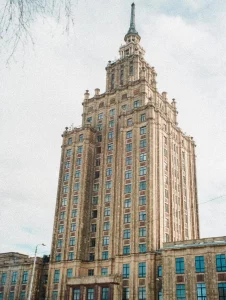
No discussion of Soviet architecture in Riga can begin anywhere other than the Latvian Academy of Sciences. This building, located just south of the Central Market on the left bank of the Daugava River, is the most iconic Soviet-era structure in the city and the one most likely to be encountered by casual visitors .
The Academy of Sciences was built in the early 1950s, during the late Stalinist period, and was designed by Lev Rudnev, the same architect responsible for the principal building of Moscow State University, one of the famous “Seven Sisters” Stalinist skyscrapers . The Riga building was intended as a smaller cousin to those Moscow giants, and it shares their characteristic tiered profile, with a central tower rising above a broader base, culminating in a spire. Locals affectionately—or perhaps ironically—nicknamed it “Stalin’s Birthday Cake” for its layered, decorative appearance .
While the Academy of Sciences is technically more Stalinist than brutalist, it is essential to any understanding of Soviet architecture in Riga. Its construction marked the beginning of the Soviet transformation of the city’s skyline, and its monumental presence established a template for later buildings. The observation deck on the 17th floor, accessible for a modest fee, offers one of the finest panoramic views of Riga, encompassing the Old Town, the Daugava River, and the sprawling residential districts that stretch into the distance .
For tourists, the Academy of Sciences is convenient and accessible. It sits within walking distance of the Central Market, itself housed in vast Zeppelin hangars that were repurposed during the Soviet era. A visit here provides a natural starting point for exploring the Soviet architectural legacy, offering both historical context and a spectacular vantage point from which to survey the city.
Zolitūde and the Residential Districts: The Concrete Suburbs
If the Academy of Sciences represents the monumental face of Soviet architecture, the residential districts of Riga represent its everyday reality. These vast housing estates, built from the 1960s through the 1980s, were designed to provide standardized apartments for the city’s growing population. They are the most extensive and least understood aspect of Riga’s Soviet heritage .
One of the most representative of these districts is Zolitūde, located in the western part of Riga, several kilometers from the city center . Zolitūde is a classic example of Soviet urban planning: a centrally planned estate composed almost entirely of prefabricated concrete block buildings in the brutalist style. Nearly 20,000 people live within its boundaries, housed in repetitive five- and nine-story apartment blocks arranged in geometric patterns .
To the uninitiated, Zolitūde and similar districts may appear monotonous or even depressing. However, for enthusiasts of brutalist architecture and Soviet urban history, they possess a strange and compelling beauty. The repetition of forms, the stark geometry of the buildings, and the way the concrete interacts with the often-gray Baltic light create a distinctive aesthetic that has attracted photographers, filmmakers, and artists from around the world.
These districts are not typically on the tourist trail, and visiting them requires a deliberate effort. They are accessible by public transport or, for the more adventurous, by bicycle or car. Several tour operators now offer guided visits to these areas, recognizing that there is a growing demand for authentic encounters with the Soviet past that go beyond the sanitized narratives of the city center .
Beyond the Center: Hidden and Unusual Sites
While the Academy of Sciences and the residential districts are the most prominent examples of Soviet architecture in Riga, the city contains numerous other sites of interest to the brutalist enthusiast. These range from monuments to industrial buildings to institutional structures, each offering a different perspective on the Soviet legacy.
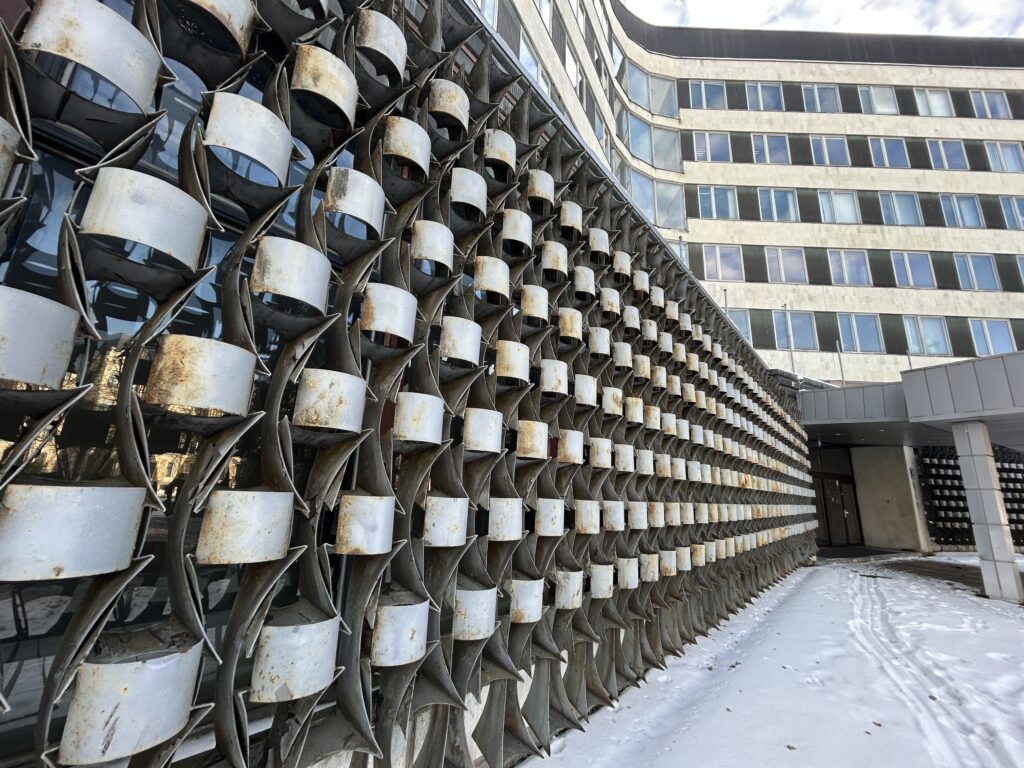
The Riga Congress Centre, built in 1982, is a fine example of late-Soviet functionalism. Located near Kronvalda Park, it originally served as the Political Education Center of the Communist Party. Its horizontal, dolomite-clad form and the large plaza in front were designed for mass gatherings and official ceremonies. Today, it has been repurposed as a venue for concerts and conferences, a symbol of how post-Soviet Latvia has adapted the infrastructure of the occupation era for democratic purposes .
The Museum of the Occupation of Latvia, situated in the Old Town near the Town Hall Square, is another significant site. The original building, constructed in 1970 to commemorate the Latvian Red Riflemen, is a dark, copper-clad structure with a windowless, boxy design that deliberately contrasts with the surrounding medieval architecture. Its brutalist aesthetic was meant to project Soviet strength and modernity. The museum now serves as a somber reminder of the occupation period, its architectural language reinforcing the gravity of its subject matter .
For those willing to venture further afield, the Riga Aviation Museum, located near the airport, offers a different kind of Soviet heritage. This museum, largely the work of one man, houses one of the largest collections of Soviet aircraft outside of Russia. While not a building in the traditional sense, the collection of MiG fighters, Mil helicopters, and other Cold War aircraft represents the technological ambition of the Soviet system. The museum’s somewhat neglected state only adds to its atmosphere of faded glory .

Why Tourists Are Drawn to Riga’s Brutalism
The growing popularity of Soviet brutalist architecture among tourists is a phenomenon that extends far beyond Riga. Across the former Eastern Bloc, from Berlin to Warsaw to Tallinn, visitors are increasingly seeking out the concrete monuments of the socialist era. In Riga, this trend is particularly pronounced, and several factors explain why.
First, there is the element of contrast. Riga’s Old Town and Art Nouveau district are undeniably beautiful, but they present a curated, perhaps even sanitized, version of the city’s history. The brutalist districts offer something rawer and more authentic, a glimpse of the lived reality of the Soviet period that is absent from the postcard image. For tourists who have already “done” the historic center, exploring the concrete suburbs provides a sense of discovery and a more complete understanding of Riga’s complex identity .
Second, there is the aesthetic appeal of brutalism itself. While the style was reviled for decades, it has undergone a critical reassessment in recent years. The stark, dramatic forms of brutalist buildings are now appreciated for their sculptural qualities, their bold use of materials, and their uncompromising rejection of decoration. Photographers, in particular, are drawn to the graphic potential of concrete facades against the sky, the interplay of light and shadow in the geometric spaces between buildings .
Third, there is the historical and political dimension. For many visitors, particularly those from Western countries with no direct experience of Soviet rule, the brutalist architecture of Riga offers a tangible connection to the Cold War era. Walking through a housing estate like Zolitūde, seeing the “CCCP” markings on aircraft at the Aviation Museum, or standing before the monumental Academy of Sciences provides a visceral sense of what the Soviet system looked like and how it shaped everyday life .
Finally, the popularity of brutalist tourism in Riga is driven in part by the passion and knowledge of local guides. Individuals such as Ance, a restoration professional who leads tours in her restored 1973 Lada, have created unique experiences that bring these buildings to life. These tours combine architectural expertise with personal stories and a genuine enthusiasm for a misunderstood era. The reviews of such experiences are overwhelmingly positive, with visitors praising the opportunity to see parts of Riga that they would never have discovered on their own .
The Future of Riga’s Brutalist Heritage
The fate of Soviet brutalist architecture in Riga is uncertain. Some buildings have already been demolished, victims of changing tastes and the desire to erase uncomfortable aspects of the past. Others face an uncertain future as they age and require costly maintenance. The residential districts, in particular, present challenges: they house large populations and are not easily adapted to contemporary standards of energy efficiency and comfort.
At the same time, there is growing recognition of the historical and architectural value of these structures. Preservation advocates argue that the brutalist heritage of Riga is an essential part of the city’s story, a physical record of a period that shaped the lives of generations of Latvians. Efforts to document and protect these buildings are underway, though progress is slow .
For tourists, the window of opportunity to experience Riga’s brutalist architecture in its current state may not remain open indefinitely. As the city continues to evolve and as attitudes toward the Soviet past shift, some of these buildings will inevitably be lost. Visiting them now, with an open mind and a willingness to look beyond surface appearances, offers a chance to engage with a complex and contested legacy.
Conclusion: A Different Kind of Beauty
Riga’s Soviet brutalist architecture is not for everyone. It lacks the charm of the Old Town and the elegance of the Art Nouveau district. Its appeal is more challenging, more intellectual, and more ambivalent. Yet for those willing to engage with it, it offers a profound and rewarding experience.
These concrete giants are monuments to a vanished ideology, witnesses to a period of occupation and resistance, and homes to communities that have endured through decades of change. They are ugly and beautiful, oppressive and fascinating, all at once. They are Riga, in all its complexity.
To walk through Zolitūde at dusk, when the setting sun casts long shadows across the prefabricated facades; to stand on the observation deck of the Academy of Sciences and survey the city spread out below; to drive through the modernist neighborhoods in a rattling old Lada while a passionate guide explains the history embedded in every concrete panel—these are experiences that reveal Riga in a new light. They are experiences that more and more travelers are seeking out, drawn by curiosity, by a desire for authenticity, and by the strange, undeniable power of raw concrete.
Book your Soviet brutalist tour in Riga with GetLocals.

Bryn Jacobs Chief Editor
Hello dear Travelers! I am Bryn Jacobs and I am your travel advisor. Having a vast experience in traveling throughout Eastern Europe and having researched this part of the world myself. I write articles on the site about travel experiences in Eastern Europe with statistics and interesting facts.